Enlightenment As I See It.

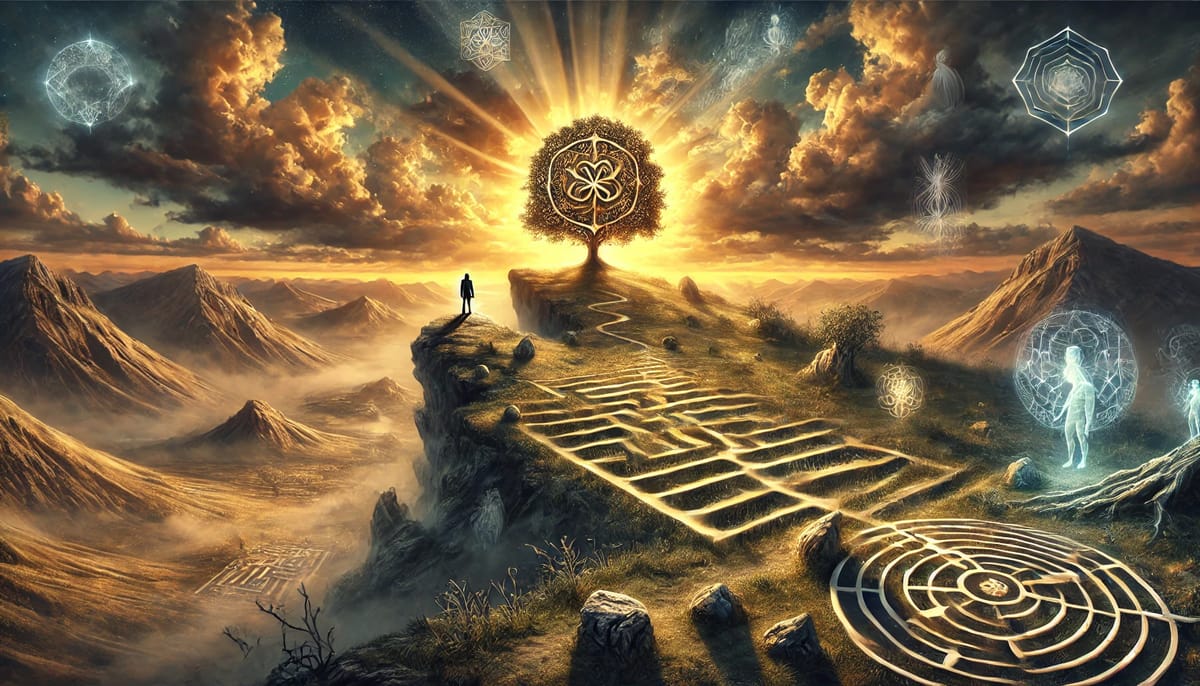
I recently shared the core concepts of the game I'm working on (tentatively entitled "Enlightenment") with a friend, and a little while later she responded with a series of questions and general thoughts. The core of her response was a question - what does enlightenment mean to you?
This is my lengthy reply, and I'm sharing it here as it is perhaps the best representation of the philosophy for this project that I've yet managed to write. Thanks, Rachel!
Enlightenment to me is the natural human process of self-actualization. Fundamentally, it seems that most human beings have a core set of conflicts derived within early development and onward, and as we continue to develop over time, it becomes necessary to recognize, process, and integrate these conflicts to achieve an ideal state of adaptive growth/becoming.
In other words, we're all a bunch of organisms with built-in puzzles that we need to solve to fully comprehend the nature of our existence and realize our greatest potential. This of course is not a prerequisite for continued existence, but I do believe it's a natural mechanism of our being that can alleviate needless self-induced suffering and increase our capacities for meaning making within the various dimensions of human life.
These so-called puzzles, found within the constantly shifting dynamics of our inner and outer experience, are highly complex and ultimately quite terrifying to grapple with. People generally seem to be averse to the discomforts of self-exploration because of the unknown implications of growth and self-change. Put simply, change feels scary to beings programmed for homeostasis.
Societal comforts, limiting beliefs, and external pressures distract us from the long-term benefits of looking inward and discovering what it really means to 'be'. We grasp onto these "certainties" instead of realizing that we cannot control anything in a universe that is always changing. Whatever specific flavor of inner conflict experienced in any personal context, our grasping for concrete certainties seems to be a universal obstacle for true self-realization. This obstacle causes us to forget critical information about our existence that would not only alleviate our conflicts but would also expand our capacities to effectively adapt to an ever-shifting reality.
Within this reality, I feel that we are experiencing something so much richer than the independent Self – each one of us is a uniquely differentiated piece of an unfathomable greater Whole that extends far beyond humankind. The patterns we see in everything around us point to this, countless wise humans have realized and shared this wisdom throughout the ages, and our core task as modern humanity is simply TO REMEMBER. But of course, remembering isn’t so simple with all the distractions and conflicts the individual currently faces. Each of us falls under illusions that mask our ability to perceive what we as a species know, deep in our bones.
Within this illusory experience, however, is the mysterious emotional experience of empathy. This naturally occurring trait of our minds, if cultivated well in early development, serves as a temporary escape hatch from our personal experience of Self, allowing us to feel, perceive, and partially know from other perspectives. When it works well, I believe empathy can completely shift one's self-perception from a state of fear (fight/flight/freeze) to a state of awe-filled acceptance and ecstatic union (realizing one's place in the interconnected whole of existence).
And I feel that a greater influx of empathy, for other humans, other life forms more broadly, and ultimately for our Selves, is how we can come back to a remembrance of our true nature. If enough individuals can remember, if enough individuals can learn to “solve” for these puzzles, if we can see that in fact, we have everything within us to do these things, through the eyes of another, then perhaps we will one day see a reduction of reactivity and increased stability for the entirety of life on our planet (and eventually, in the cosmos).
That’s the core intuition that drives the mission, vision and design philosophy of this game. I believe that every living person can access their own enlightenment, in their own unique way, no matter the life circumstances. It’s just damn hard in our present cultural circumstances.
So why not lean into existing systems that our minds automatically comprehend?
Games, books, TV shows, and social media are all ultimately undergirded by narrative; through narrative, we tell each other stories of our personal emotional experience and we also come to passively empathize with other people’s emotional experiences. This works especially well in fictional contexts. Recall the last time you watched an intense movie, or got really immersed in a profound novel – were you thinking about your Self experience while keeping track of the story playing out in front of you? Of course not! When we engage deeply with art, our minds seem to take a step away from the personal experience we live every day to partake in another’s experience, and this often evokes feelings of curiosity, awe, and wonder.
Now consider what happens when someone plays a great game. All the above effects take place and are then enhanced by player agency. Players get to make choices that impact the story they’re encountering, subconsciously linking their mind with the mind(s) of the characters within the story in varying degrees, and in turn generating a heightened sense of emotional connectivity and resonance that very often leads to highly impactful experience. There are many documented examples of games (particularly, those created by indie developers) that have plucked many a player’s heartstrings. But I believe that we’ve only just scratched the surface of the ramifications of narrative immersion, and I want to explore this in my work.
I believe it’s possible to create a game that immerses players in the story of another being (a protagonist suffering from amnesia) whose story is designed to procedurally mirror the unique personality of the players themselves. In doing so, several things may become possible; people would be given the opportunity to engage with a compelling narrative that entertains and entrances their mind, they would take part in a highly agentic emotional connection with a character who needs their help, and ultimately, they would discover their own capacity for self-empathy in the process.
There’s much more to be said about the science behind my hunch here, but I see a clear logic and possibility in this form of affective storytelling. To my mind, this presents an experience for transformative change within the hearts and minds of people who may struggle with the puzzles inherent in their lived experience. Going further, it may even be an avenue for individuals who are unable to experience empathy due to the circumstances of their development to understand more viscerally what this quality of the human mind really feels like.
To really explore those last claims, this game will need to evolve into something that surpasses our traditional notion of what games can be. It will need to become a new technology of sorts, one created with the ultimate intent of making enlightenment accessible to the world in a way that perhaps has never been possible before.